AI just solved a $1m maths problem.
OpenAI, September 2026, as reported by Quanta Magazine.
AI is reshaping the world our pupils will grow up in. Eden prepares every pupil for it, through entrepreneurship.
Ten 40-minute sessions, led by your own teachers, for a group of 8 to 16 pupils.
AI can already do much of the finished work.
Done, before you finished reading this line.
Some schools are already rebuilding the day around it. See how
Alpha School, Texas: CBS News, 2 October 2025. Andreessen Horowitz: a16z, 22 September 2026.
So how will our pupils thrive? With what AI cannot supply.
Judgement.
Problem solving.
Collaboration.
Creativity.
Communication.
How do we teach them? Through entrepreneurship. It needs every one of these skills at once, on a real problem, for real people.
Every school has a problem nobody has fixed.
Name one, and watch what your pupils would do with it.
Start with one group.
Entrepreneurship has usually been offered to a few pupils who chose it. In an AI world every pupil needs these skills, whichever path they take.
Your first group
Problemone your pupils choose
Heads ask: · · · Why this works
Cost: agreed with your school, paid up front for the ten sessions. Eden can be funded by parents.
Reaching the whole year group is the hard part. Eden is built for it, and the club stays for those who want more.
Ivan Ante, CFA, founder of Flosendo, from three generations of teachers. After fourteen years in investment management he became a Sloan Fellow at London Business School, which gave him its Social Good Award in 2026. He built Eden around how pupils learn. We completed an Eden school pilot at St Augustine and used teacher and student feedback to shape the programme. Flosendo is part of the LBS Incubator Programme. Meet Ivan
Why this works
What we are here for: preparing every pupil for a world AI is reshaping, with the skills it cannot supply.
Prepare early
Entrepreneurship trains pupils need now, and shows them early, when universities increasingly ask .
The skills. In 2018 the EU named entrepreneurship one of eight key competences that all individuals need. England already expects every pupil, every year from 11, to meet an employer, and counts enterprise schemes as one way to do it. Council of the European Union, 2018. The Gatsby benchmarks, England.
The paths. Whichever path a pupil takes (university, an apprenticeship, a first job or their own venture), the same human skills carry them.
Building counts. MIT invites applicants to send a Maker Portfolio: projects of their own design and making. Ivan’s view is that, increasingly, what a student has built will be a key question for the most selective universities. MIT Admissions, Creative portfolios.
Empathy is the method
Pupils start with the people who have the problem, not their own idea. It teaches , around .
The method. Most people start with their own idea. Pupils start with the people who have the problem: understand them, then add value for them.
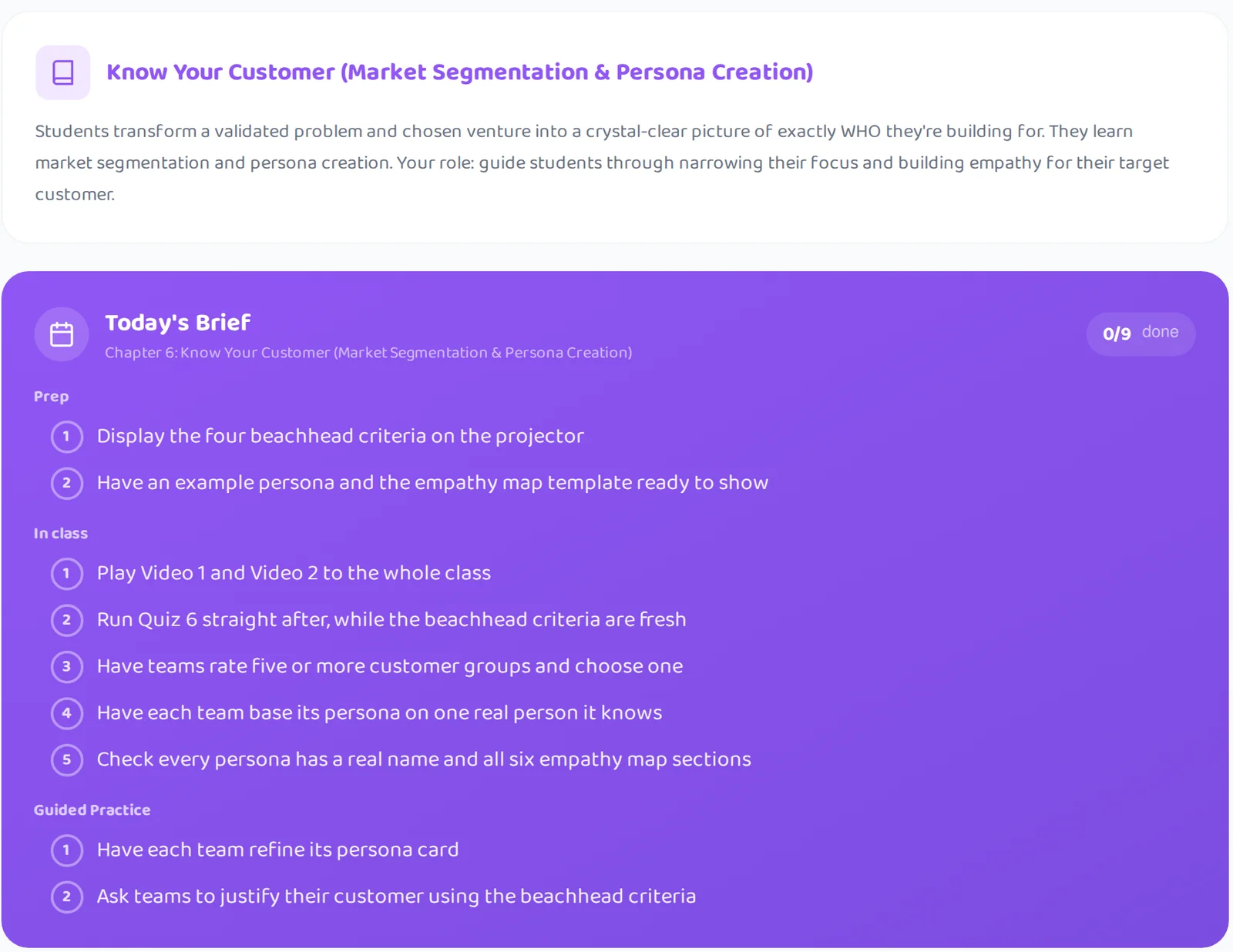
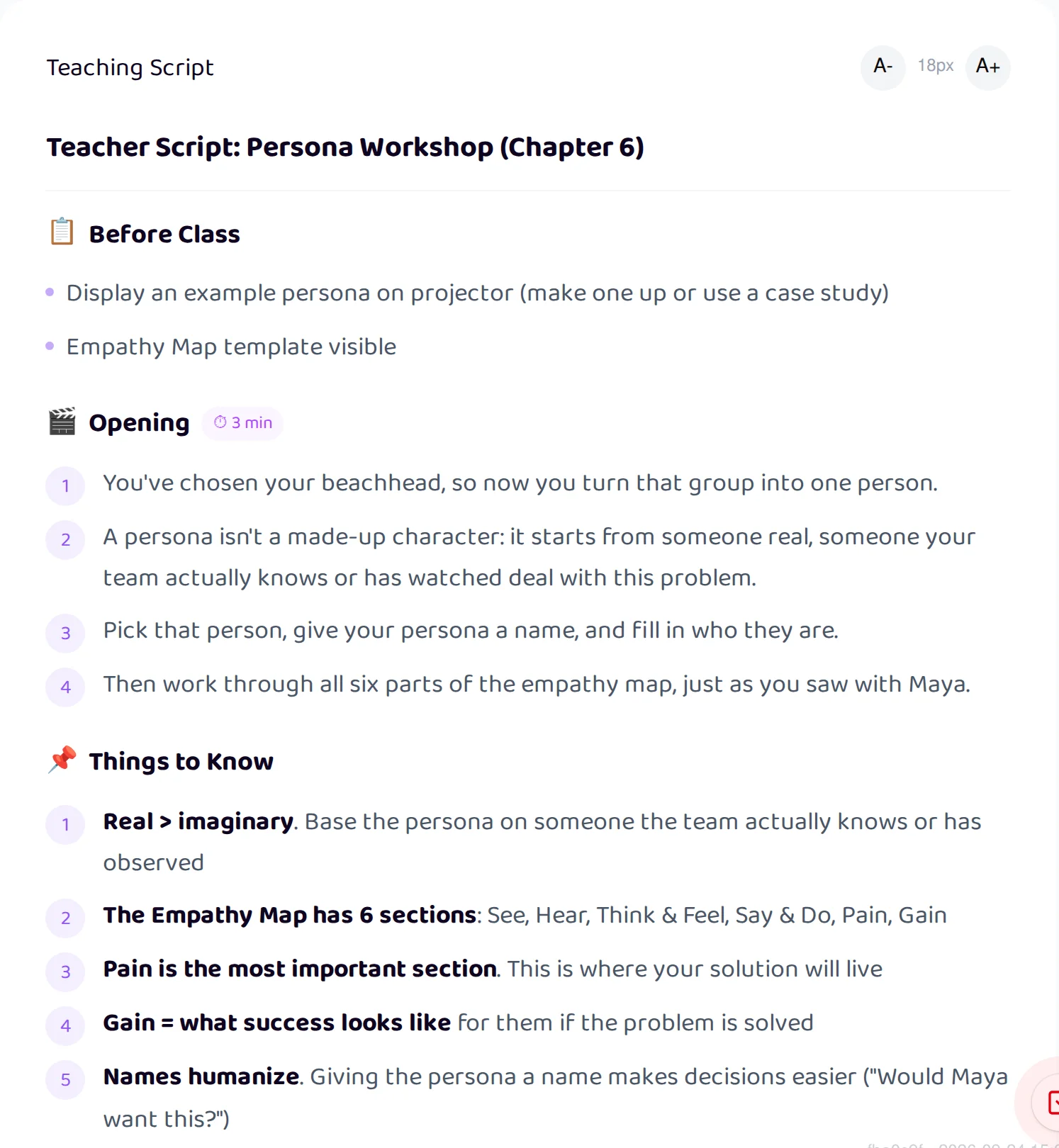
Chapter 6. Teams build a persona and an empathy map for one real person they have spoken to.
Does it work?
Start-ups often fail because founders build what . Entrepreneurship , like any skill. Taught properly, it works:
The cause. Of start-ups that failed, 43% had built something the market did not want. A proper method tackles that first. CB Insights, March 2026.
A skill like any other. MIT’s Bill Aulet puts it plainly in Disciplined Entrepreneurship: ‘now I know that entrepreneurship can be taught.’ His book breaks it into 24 steps; Eden adapts them for secondary pupils, in four stages over ten sessions. Aulet, Wiley 2013.
69% of delta v projects from its most recent five years became companies that are still going or were acquired (61% across all ten years).
63% of all its projects raised money.
Over $1 billion raised by those companies.
69 is the participants’ average Net Promoter Score, across all cohorts.
MIT’s delta v accelerator, taught with Disciplined Entrepreneurship: ten years, 181 teams, 692 participants. Martin Trust Center, MIT; D-eship, 2020. These are MIT’s results; Eden adapts its method.
So Eden builds the right mindset first, and makes it relevant to pupils, with respect, so they own it.
The skill stack
Ivan’s view: pupils need a stack of skills for an AI world. School builds the first two. Eden adds and .
Entrepreneurial. The ten sessions: a real problem, real people, a live pitch.
Tool mastery. AI used well inside it: AI suggests, pupils decide. Pupils bring their project work, never personal data, and the school decides the tools.
Eden School
Your teacher's week
One session a week, in class, with its aim, its steps and a script ready in the app. One hour of onboarding at the start. No enterprise background is assumed.
Minutes are the teacher plan's; each school's timetable sets the session length. From the Eden teacher plans.
Built on learning science
Recalling beats rereading: a week later, pupils who practised recall . Eden’s do exactly that.
The study. A week later, students who practised recalling a text remembered 61% of it. Students who reread it four times as often remembered 40%, and felt more confident. Roediger and Karpicke, Psychological Science, 2006.
In Eden. Eden’s flashcards and quizzes are retrieval practice: they bring each session back.

Founder and CEO, Flosendo
Meet Ivan
“AI will reshape careers. Few people are building for students who’ll inherit that world. So we are.”
Family. Three generations of his family have taught: his grandmother, his father, and now Ivan. “Education is not a sector I entered,” he says. “It is where I come from.”
14 years. From analyst to Head of Global Multi-Asset Strategies and Senior Portfolio Manager at ATRAM, overseeing more than US$2 billion.
2023. An education start-up in the Philippines, matching university students as mentors with students preparing for college entrance tests. His lesson from it: “I wasn’t building for customers. I was building for myself. That was my wake-up call.” Eden’s pupils start with other people.
London. The Sloan Masters at London Business School is a 12-month, full-time masters for senior leaders. LBS describes Sloan Fellows as executives, professionals and entrepreneurs with an average of 18 years’ experience. Flosendo is part of the LBS Incubator Programme.
2026. Mentor at the LBS AI Lab, and a guest speaker on practical AI for LBS leadership cohorts. At the School’s Enterprise for Schools day he ran two entrepreneurship sessions for about fifty Year 11 pupils from four London schools. At graduation in 2026, London Business School gave him its Social Good Award, for service to the School and the wider community.
Now. Entrepreneurship for every pupil, built around how pupils learn. At St Augustine’s CE High School, a Year 10 class on the King’s Trust programme had one Eden session a week. Their teacher, Abdel Ydri, championed the pilot, and Ivan met him before each session. His advice: “Activity list is key. Make it extremely specific and visual.” Pupils outside the class kept asking him, “Mr Ydri, can we join this class?” Teacher and pupil feedback shaped the programme.
How Ivan designs for learning: , , and . In his words, he is .
The whole first. Pupils take in what they learn when they see how each step fits the whole, because then it matters to them.
Why before how. Every activity opens with why it matters, then how to do it.
Prompts, not blank pages. Pupils work from guided prompts and real examples, never an empty box.
Recall, not rereading. Eden’s flashcards and quizzes bring each session back. That is retrieval practice (see Built on learning science).
In his words. “I’ve been a learning science enthusiast for years. I enrolled in meta-learning courses myself because I needed to learn a lot, fast.”
London Business School admissions blog, 2 February 2026. LBS Think, 3 February 2026 (read Ivan’s article). Ivan’s product principles for Flosendo.
Food for thought
Schools here and abroad are already changing how pupils learn with AI. Eden brings that way of working to every pupil in a year group, in school, with their own teachers.
Show · · ·
In Austin, Texas, Alpha School teaches academics in two hours a morning with AI. The afternoons go to projects, financial literacy and public speaking. Read the source
A school for young people leaving high school, where they work on their own projects instead of taking tests, for a first class of about 50. Read the source
In September 2024 it opened a GCSE class of 20 pupils who learn with AI platforms, supported by learning coaches rather than subject teachers. Read the source
EDGE, a social entrepreneurship certificate for Years 10 and 11, is taken alongside GCSEs and built with Nottingham University Business School and Enactus UK. Pupils design and launch their own social enterprises. Read the source
The government will publish a revised national curriculum in 2027, for first teaching from September 2028, and will explore a new level 3 qualification in data science and AI. Read the source
In the World Economic Forum's 2025 survey of over 1,000 employers, they expect 39% of workers' core skills to change by 2030. Analytical thinking is the skill they rate most essential. Read the source
MIT's Bill Aulet puts it plainly in Disciplined Entrepreneurship: 'now I know that entrepreneurship can be taught.' His book breaks it into 24 steps. Read the source
MIT invites applicants to send a Maker Portfolio: projects of their own design and making. Read the source